
Gas vs Diesel Poultry Heaters
Gas vs Diesel Poultry Heaters

Gas vs Diesel Poultry Heaters: Which Heating System Is Better?
Choosing the right heating system is an important decision for any poultry farm.
Heating requirements can represent a significant part of operating costs, especially during cold weather and the brooding period. For this reason, poultry producers often compare different fuel options before investing in a new heating system.
Two commonly used options are gas-fired and diesel-fired poultry heaters.
But which one is better?
The answer depends on the individual poultry farm. Fuel availability, local energy prices, infrastructure, climate, house size, ventilation requirements and operating conditions all affect the final decision.
In this guide, we compare gas and diesel poultry heaters and explain the main advantages and considerations of each system.
Gas and Diesel Poultry Heating: What Is the Difference?
The fundamental difference is the fuel used to generate heat.
Gas-fired poultry heaters use fuels such as natural gas or LPG, while diesel heaters use liquid fuel.
Both technologies can provide high heating capacity and can be used for poultry houses requiring substantial amounts of heat.
Modern forced-air heaters transfer the generated heat into the poultry house through heated air, allowing the system to distribute warmth throughout the building.
The important question is therefore not simply which fuel produces more heat.
Instead, poultry producers should ask:
Which heating system provides the best overall solution for this particular farm?
Natural Gas Poultry Heaters
Natural gas can be an attractive heating option for poultry farms located in areas with reliable natural gas infrastructure.
One of the main advantages is the continuous availability of fuel through the gas network.
Natural gas heating can be particularly practical for farms operating multiple poultry houses because there is no need to store large quantities of liquid fuel on site.
Natural gas-fired forced-air heaters can provide:
- High heating capacity
- Rapid temperature response
- Continuous fuel supply
- Easy integration into automated systems
- Efficient heat generation
- Reduced need for on-site fuel storage
However, natural gas is only practical when suitable infrastructure is available.
LPG Poultry Heaters
LPG provides another gas-based heating option.
Unlike natural gas, LPG does not require a connection to a natural gas network. It can be stored in tanks and supplied directly to the heating system.
This makes LPG particularly useful in locations where natural gas infrastructure is unavailable.
LPG can provide the high heating capacity required by large poultry houses, but the cost of LPG and the required storage infrastructure should be considered when calculating total operating costs.
Mira Heating's AGH poultry heaters are designed for natural gas and LPG applications:
https://www.miraheating.com/agh-dogalgazlpgli-kumes-isitici
Diesel Poultry Heaters
Diesel-fired heaters are widely used in applications where liquid fuel is readily available.
One of their main advantages is flexibility.
A poultry farm does not need to be connected to a natural gas network to operate a diesel heating system.
Diesel heaters can provide high heating capacity and rapid heating, making them suitable for large agricultural buildings and poultry houses.
They can be particularly practical in remote locations where gas infrastructure is limited.
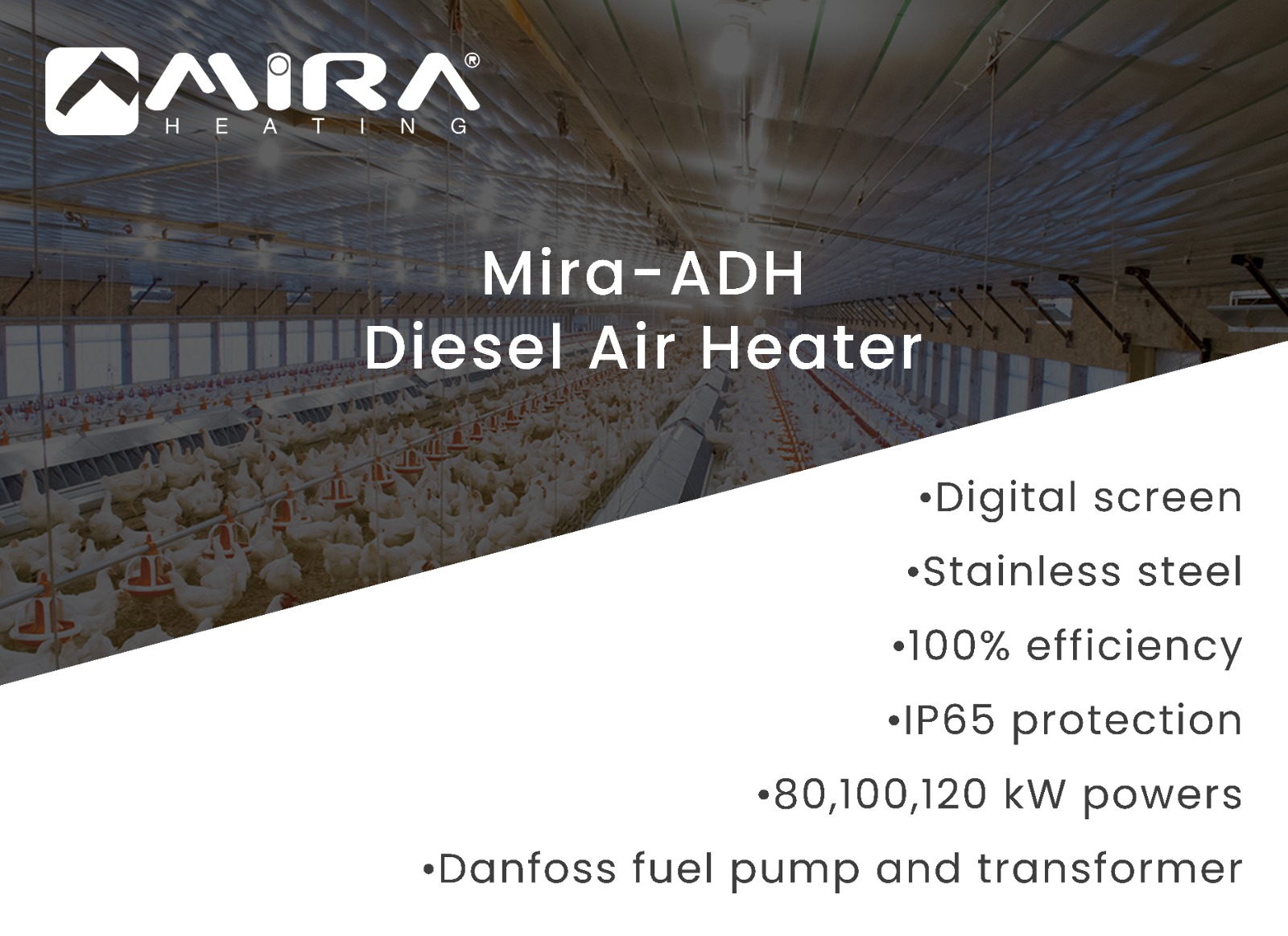
Mira Heating provides diesel-fired heaters for agricultural and poultry applications:
https://www.miraheating.com/mira-adh-mazotlu-isitici
Gas vs Diesel: Heating Performance
Both gas and diesel heaters can provide sufficient heating capacity for poultry houses when properly selected.
The actual performance depends on the heater design, heating capacity, airflow, installation and control system.
A high-capacity heater that is incorrectly installed may perform worse than a correctly designed system with lower nominal capacity.
For this reason, heating performance should be evaluated as a complete system.
Important factors include:
- Heating capacity
- Heat distribution
- Airflow
- Heater placement
- Temperature control
- Ventilation
- Building insulation
The fuel alone does not determine the final performance of the heating system.
Gas vs Diesel: Operating Cost
Operating cost is usually one of the most important considerations when comparing heating systems.
However, comparing only the price of a litre of diesel with the price of a cubic metre of natural gas can be misleading.
Different fuels contain different amounts of energy, and heater efficiency also affects how much useful heat reaches the poultry house.
A proper comparison should consider:
Fuel price + fuel consumption + heater efficiency + maintenance + infrastructure
For example, a fuel that appears cheaper per unit may not necessarily produce the lowest total heating cost.
Local energy prices should therefore be used when evaluating the most economical option for a specific farm.
Gas vs Diesel: Installation
Installation requirements are another important difference.
A natural gas heating system requires an appropriate gas supply and installation according to local regulations.
LPG systems require suitable fuel storage and gas supply equipment.
Diesel systems require a suitable fuel storage tank and fuel supply system.
The installation should always be designed according to the applicable local safety requirements.
The location of the heater, fuel system, ventilation and electrical components should also be considered as part of the overall poultry house design.
Gas vs Diesel: Fuel Storage
Fuel storage can have a major impact on the practicality of a heating system.
Natural gas supplied through a network generally requires little on-site fuel storage.
LPG requires tanks or cylinders depending on the installation.
Diesel requires a suitable fuel storage tank.
The availability of storage space, fuel delivery frequency and local regulations should therefore be considered before choosing a system.
For farms located in remote areas, the ability to store fuel on site can be an important factor.
Gas vs Diesel During Cold Weather
Heating demand increases significantly during periods of low outdoor temperature.
A heating system must therefore be able to provide sufficient capacity under the expected winter conditions.
This is particularly important for poultry houses in regions with large differences between summer and winter temperatures.
The system should be sized according to the design outdoor temperature, rather than average seasonal temperature.
A heating system that performs adequately under normal conditions may struggle during extreme cold if it has been undersized.
Heater Placement Is Important for Both Systems
Whether the poultry farm uses gas or diesel, heater placement remains critical.
Incorrect positioning can create temperature differences throughout the house.
Birds may gather in warm areas while avoiding colder zones.
This can reduce the effective use of the poultry house and make temperature management more difficult.
For forced-air systems, the direction of warm air and the interaction with ventilation airflow should be considered carefully.
Our guide on heater placement explains this in more detail:
https://www.miraheating.com/haber-heater-placement-poultry-houses
Heating and Ventilation Must Work Together
Neither gas nor diesel heating should be considered independently from ventilation.
Poultry houses require fresh air to maintain appropriate air quality.
However, ventilation also removes heat.
If excessive amounts of cold outside air enter the building, the heating system must work harder to maintain temperature.
On the other hand, insufficient ventilation can result in poor air quality and excessive humidity.
An efficient poultry house therefore needs a balance between:
- Heating
- Fresh air
- Air distribution
- Humidity control
- Temperature
- Energy consumption
Gas vs Diesel During Brooding
The brooding period places particularly high demands on the heating system.
Young chicks require a warm and stable environment, making heating performance especially important during the first days and weeks.
Both gas and diesel heaters can be used for brooding applications when properly sized and controlled.
The important factors are:
- Stable temperature
- Uniform heat distribution
- Correct heater placement
- Reliable temperature control
- Appropriate ventilation
The heating system should be capable of responding to changing conditions as the flock develops.
Which Is Better for Large Poultry Farms?
For large poultry farms, both gas and diesel can be suitable.
However, the infrastructure of the farm becomes increasingly important as the number of poultry houses increases.
Natural gas can be particularly attractive where a reliable gas network is available.
LPG can be a practical alternative where natural gas is unavailable but gas heating is preferred.
Diesel can provide flexibility for farms where liquid fuel infrastructure is already established.
There is therefore no universal answer.
The best system is the one that provides the required heating capacity at an acceptable total operating cost while fitting the farm's infrastructure.
Which Is Better for Remote Poultry Farms?
Remote farms may have limited access to natural gas infrastructure.
In such cases, LPG or diesel can provide greater flexibility.
The decision should consider:
- Fuel availability
- Delivery logistics
- Storage capacity
- Local fuel prices
- Required heating capacity
- Maintenance support
For a remote farm, reliable fuel supply can be just as important as fuel price.
A theoretically cheaper heating system is not useful if fuel cannot be delivered reliably during winter.
Gas vs Diesel: Maintenance
Both gas and diesel heating systems require regular maintenance.
Maintenance requirements depend on the heater design and operating conditions.
Regular checks can include:
- Burner operation
- Fuel supply
- Pressure
- Fan operation
- Airflow
- Electrical components
- Temperature controls
- Combustion performance
- Heat exchanger condition
Regular maintenance helps maintain heating performance and reduces the risk of unexpected failures during critical production periods.
What About Electric Heating?
Although gas and diesel are common choices for high-capacity poultry heating, electricity can also be used in certain applications.
Electric heaters can be suitable for smaller poultry houses, specific zones or supplementary heating.
However, for large poultry houses, electricity costs and available electrical capacity should be evaluated carefully.
Mira Heating also provides electric fan heaters for poultry and agricultural applications:
https://www.miraheating.com/eh-36-elektrikli-fanli-isitici-kumes-sera-isitici
Gas vs Diesel: Quick Comparison
| Factor | Natural Gas | LPG | Diesel |
|---|---|---|---|
| Heating capacity | High | High | High |
| Fuel storage | Usually not required | Required | Required |
| Natural gas network | Required | Not required | Not required |
| Remote farm suitability | Limited | High | High |
| Installation infrastructure | Gas connection | LPG storage | Diesel storage |
| Heating response | Fast | Fast | Fast |
| Large poultry houses | Suitable | Suitable | Suitable |
| Operating cost | Location dependent | Location dependent | Location dependent |
| Fuel availability | Region dependent | Generally flexible | Generally flexible |
The table provides a general comparison. Actual suitability and operating costs depend on local conditions and the specific heating system.
How Should a Poultry Farm Choose?
The best way to select a poultry heating system is to evaluate the complete project before purchasing equipment.
The following questions should be answered:
What is the size of the poultry house?
Length, width and height directly affect heating requirements.
What is the minimum outdoor temperature?
The heating system should be sized according to the expected winter conditions.
How well is the building insulated?
Poor insulation increases heating demand regardless of fuel type.
What fuel is available?
Natural gas, LPG and diesel availability varies significantly between locations.
What is the local fuel price?
Operating cost should be calculated using actual local prices.
How much ventilation is required?
Ventilation affects both air quality and heating demand.
How will the heaters be positioned?
Heat distribution should be considered before installation.
What is the long-term operating cost?
The initial equipment price should not be the only consideration.
So, Is Gas or Diesel Better?
There is no single answer that applies to every poultry farm.
Natural gas can be an efficient and practical option where gas infrastructure is available.
LPG provides flexibility for farms that do not have access to a natural gas network but still want to use gas-fired heating.
Diesel can be a practical solution where liquid fuel is readily available or where the farm is located away from gas infrastructure.
The right choice depends on the combination of fuel availability, local energy prices, infrastructure, climate, poultry house design and operating requirements.
The most important point is to compare the complete heating system, not just the fuel.
Conclusion
Choosing between gas and diesel poultry heaters is an important investment decision, but there is no universally superior fuel.
Natural gas, LPG and diesel can all provide effective heating for poultry houses when the system is correctly sized, installed and maintained.
The most important factors to consider are:
- Heating capacity
- Fuel availability
- Local energy prices
- Building insulation
- Ventilation
- Heater placement
- Heat distribution
- Maintenance
- Total operating cost
For poultry farms with natural gas infrastructure, gas heating can be a highly practical solution. LPG can provide flexibility where natural gas is unavailable, while diesel can be particularly useful for farms with established liquid-fuel infrastructure or remote locations.
At Mira Heating, we provide natural gas, LPG, diesel and electric heating solutions for poultry farms and agricultural applications. If you are comparing heating options for a new poultry house or considering replacing an existing system, contact our team with your poultry house dimensions, location and available fuel options so we can help you evaluate the most suitable heating solution for your project.