
Heater Placement in Poultry Houses
Heater Placement in Poultry Houses

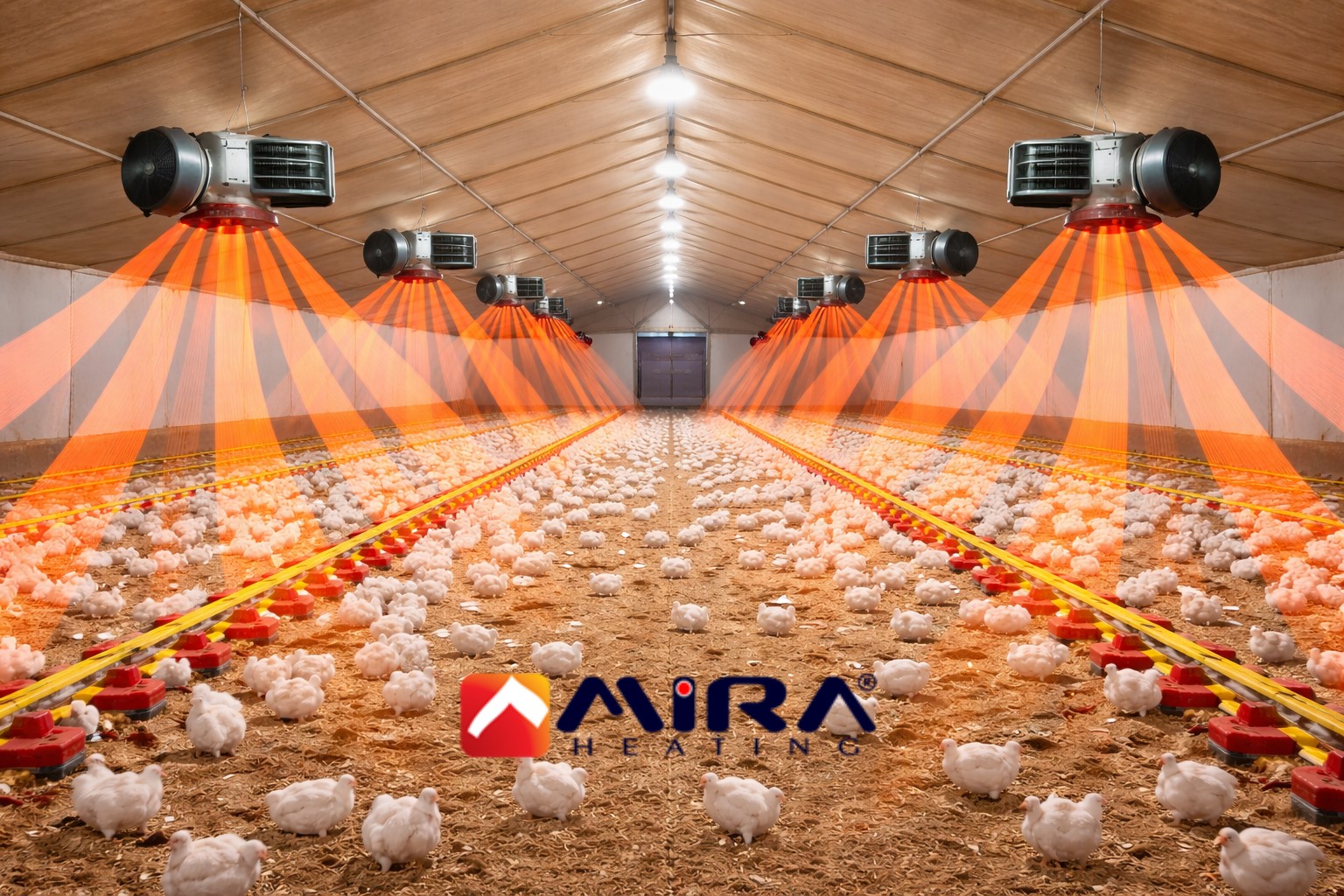
Poultry House Heating and Ventilation: How to Balance Temperature and Fresh Air
Heating and ventilation are two of the most important systems in a modern poultry house.
They are also closely connected.
Heating is responsible for maintaining the required temperature, while ventilation provides fresh air and removes moisture, carbon dioxide, ammonia and other unwanted gases.
The challenge is that ventilation also removes heat.
When cold outdoor air enters the poultry house, the heating system must provide additional energy to bring that air to the required indoor temperature.
This means that a poultry house cannot be managed efficiently by looking at heating and ventilation separately.
The two systems must work together.
A well-designed poultry house heating and ventilation system should provide:
- Suitable temperature
- Fresh air
- Controlled humidity
- Appropriate air movement
- Good air quality
- Uniform conditions
- Efficient energy use
Why Do Poultry Houses Need Ventilation?
Poultry birds continuously produce heat, moisture and carbon dioxide.
Litter and manure can also contribute to moisture and ammonia levels.
Without sufficient ventilation, these conditions can deteriorate quickly.
Ventilation helps remove:
- Moisture
- Carbon dioxide
- Ammonia
- Dust
- Excess heat
- Contaminated air
At the same time, fresh outdoor air must be introduced into the building.
This is particularly important in modern, relatively airtight poultry houses.
Why Does Ventilation Increase Heating Demand?
During cold weather, outdoor air may be significantly colder than the air inside the poultry house.
When this air enters the building, it must be heated.
For example, if the poultry house needs to remain warm while the outdoor temperature is very low, every increase in ventilation can increase the amount of heat required.
This creates an important balance:
More ventilation = more heat loss
but
Insufficient ventilation = poor air quality
The goal is therefore not to minimize ventilation.
The goal is to provide the correct amount of ventilation with controlled air movement.
What Is Minimum Ventilation?
Minimum ventilation refers to the amount of fresh air required to maintain acceptable indoor air quality when heating demand is high.
It is particularly important during cold weather and the early stages of production.
The purpose is to remove unwanted gases and moisture while limiting unnecessary heat loss.
Minimum ventilation should be carefully controlled rather than simply opening large areas of the building.
Why Uncontrolled Air Leakage Is a Problem
There is an important difference between planned ventilation and uncontrolled air leakage.
Planned ventilation introduces air through designated inlets.
Uncontrolled air leakage occurs through:
- Door gaps
- Wall joints
- Damaged panels
- Service openings
- Poorly sealed doors
- Building cracks
Cold air entering through these areas can reach the birds directly and create drafts.
It can also increase heating demand.
A well-insulated and properly sealed poultry house allows ventilation to be controlled much more effectively.
How Should Fresh Air Enter a Poultry House?
Fresh air should ideally enter through properly designed and controlled air inlets.
The incoming air should be directed in a way that encourages it to mix with warmer air before reaching the bird level.
This is especially important during cold weather.
If cold air falls directly onto the birds, the actual conditions at bird level can be much colder than the temperature measured elsewhere in the building.
Correct air inlet adjustment is therefore an important part of climate management.
Heating and Ventilation Must Work Together
A heating system and ventilation system should be considered as one climate-control system.
For example:
When ventilation increases, heating demand increases.
When ventilation decreases, heat loss decreases but air quality can deteriorate.
The control system must therefore balance the two.
A modern poultry house should aim for:
Fresh air without unnecessary heat loss.
The Role of Forced-Air Heating
Forced-air heaters can be particularly useful in this environment because they combine heating with air movement.
The heater produces heat and the fan distributes warm air through the building.
This can help mix warmer air with incoming fresh air.
However, the airflow must be correctly designed.
Excessive airflow at bird level can create drafts.
Insufficient airflow can result in poor heat distribution.
The objective is to achieve controlled heat distribution without creating uncomfortable air movement.
Heater Placement Matters
The position of a forced-air heater affects both heating and ventilation performance.
Heaters should be positioned according to:
- Poultry house dimensions
- Ventilation inlet locations
- Exhaust fan locations
- Airflow direction
- Bird area
- Temperature sensors
Incorrect positioning can cause the heating system to work against the ventilation system.
For more information about heater placement:
https://www.miraheating.com/haber-heater-placement-poultry-houses
Exhaust Fans and Heating
Exhaust fans remove air from the poultry house.
When a fan operates, replacement air must enter the building.
If the air enters through controlled inlets, the airflow can be managed.
If the building has uncontrolled openings, however, cold air may enter through random locations.
This can create drafts and increase heat loss.
The interaction between exhaust fans, air inlets and heaters should therefore be considered during system design.
Airflow Direction Is Important
The temperature of the incoming air is not the only consideration.
The direction and velocity of the air are also important.
Air entering the building should ideally travel through the upper part of the poultry house and mix with warmer indoor air before reaching the birds.
This helps reduce the risk of cold drafts at bird level.
The exact airflow pattern depends on the building dimensions, inlet design, fan capacity and heating system.
Heating During Winter
Winter is when the relationship between heating and ventilation becomes particularly important.
Outdoor temperatures may be very low, but the poultry house still requires fresh air.
The heating system must therefore compensate for:
- Heat loss through the building
- Heat loss through ventilation
- Uncontrolled air leakage
This is why good insulation and controlled ventilation can significantly reduce heating costs.
Heating During Brooding
The challenge is even greater during brooding.
Young chicks require a warmer environment while still requiring fresh air.
The heating system therefore needs to maintain the required temperature without preventing adequate ventilation.
This is one of the reasons why heater placement and airflow are so important during the early stages of production.
For more information:
https://www.miraheating.com/haber-brooding-temperature-management-poultry
Temperature Uniformity
A poultry house should not be evaluated based on a single temperature measurement.
Different areas can have different conditions because of:
- Heater locations
- Air inlets
- Exhaust fans
- Insulation
- Building orientation
- Doors
- Outdoor conditions
Multiple measurement points can provide a better understanding of the actual environment.
Temperature should also be evaluated together with bird distribution.
Humidity and Ventilation
Ventilation also plays a major role in humidity control.
Excess moisture can contribute to:
- Wet litter
- Ammonia problems
- Poor air quality
- Condensation
- Uncomfortable conditions
Heating alone cannot solve a humidity problem.
The moisture must ultimately be removed through appropriate ventilation.
This is another reason why heating and ventilation should be designed as an integrated system.
Carbon Dioxide and Air Quality
Birds produce carbon dioxide as part of normal respiration.
If ventilation is insufficient, carbon dioxide levels can increase.
The same principle applies to other unwanted gases and contaminants.
A poultry house may have an acceptable temperature but poor air quality.
This is why temperature should never be the only parameter used to evaluate the indoor environment.
Ammonia and Litter Conditions
Poor ventilation can contribute to increased moisture and ammonia levels.
Wet litter is particularly problematic because it can affect the overall environment inside the poultry house.
Maintaining appropriate ventilation helps remove moisture from the building.
However, litter management, stocking density, drinking systems and other factors also influence litter condition.
Climate control is therefore one part of a broader management strategy.
Can You Reduce Ventilation to Save Heating Costs?
This is a common question during cold weather.
The short answer is: not without considering air quality.
Reducing ventilation may reduce heating demand temporarily.
However, insufficient ventilation can lead to increased:
- Humidity
- Carbon dioxide
- Ammonia
- Condensation
- Litter moisture
The correct strategy is to optimize ventilation rather than simply reducing it.
How Better Insulation Helps Heating and Ventilation
Good insulation reduces the amount of heat that escapes through the building envelope.
This allows the heating system to maintain temperature with less energy.
It also means that ventilation can be managed according to air quality requirements rather than being used to compensate for excessive heat loss.
The combination of:
Good insulation + controlled ventilation + efficient heating
can significantly improve the overall performance of a poultry house.
Heating Systems for Different Fuel Types
Poultry farms can use different fuel sources depending on their location and infrastructure.
Common options include:
- Natural gas
- LPG
- Diesel
- Electricity
Each option can be suitable for different applications.
Natural Gas Poultry Heating
Natural gas is a practical option for farms connected to a gas network.
It can provide high heating capacity without requiring on-site liquid fuel storage.
Mira Heating's AGH range provides natural gas and LPG poultry heating solutions:
https://www.miraheating.com/agh-dogalgazlpgli-kumes-isitici
LPG Poultry Heating
LPG provides an alternative where natural gas is unavailable.
It can be stored on the farm and used with suitable gas-fired heating equipment.
Fuel storage capacity and delivery logistics should be considered when evaluating LPG heating.
Diesel Poultry Heating
Diesel-fired forced-air heaters can be suitable for farms where liquid fuel is readily available.
They can provide high heating capacity and rapid heating response.
Mira Heating provides diesel heating solutions for agricultural applications:
https://www.miraheating.com/mira-adh-mazotlu-isitici
Electric Poultry Heating
Electric heating can be suitable for smaller poultry houses, supplementary heating or applications with sufficient electrical capacity.
Mira Heating provides electric fan heaters for poultry and agricultural applications:
https://www.miraheating.com/eh-36-elektrikli-fanli-isitici-kumes-sera-isitici
How to Improve Heating and Ventilation Efficiency
Several practical improvements can help optimize the system.
- Check building insulation
Make sure walls, roof and doors are properly insulated. - Seal uncontrolled openings
Prevent cold air from entering through unintended gaps. - Adjust ventilation inlets
Make sure incoming air follows the intended path. - Check heater placement
Ensure warm air reaches the required areas. - Maintain exhaust fans
Poor fan performance can change the designed airflow. - Check temperature sensors
Sensors should represent the conditions experienced by the birds. - Monitor bird behaviour
Uneven bird distribution can reveal temperature or airflow problems. - Maintain heating equipment
Burners, fans, controls and other components should be inspected regularly.
Heating and Ventilation During Different Seasons
The balance between the two systems changes throughout the year.
- Winter
Heating demand is high and ventilation must be carefully controlled. - Spring and Autumn
Outdoor temperatures vary considerably, so heating and ventilation may need to adjust frequently. - Summer
Heating may not be required, but ventilation and cooling become increasingly important.
A flexible climate-control system can respond to these changing conditions.
A Practical Poultry Climate Checklist
Before each production cycle, check:
| Area | Checklist Items |
|---|---|
| Building |
|
| Heating |
|
| Ventilation |
|
| Control |
|
| Flock |
|
This simple checklist can identify many potential problems before they become major issues.
The Goal Is Balance
An efficient poultry house does not maximize either heating or ventilation.
It balances both.
The objective is:
Enough ventilation to maintain air quality + enough heating to maintain the required temperature + enough insulation to prevent unnecessary heat loss.
This balance is at the heart of efficient poultry climate management.
Conclusion
Heating and ventilation should never be treated as completely separate systems in a poultry house.
Ventilation provides fresh air and removes moisture and unwanted gases, but it also removes heat.
Heating compensates for this heat loss while maintaining the temperature required by the flock.
The best results come from integrating:
Heating + Ventilation + Insulation + Airflow + Temperature Control + Flock Management
Natural gas, LPG, diesel and electric heating systems can all be used depending on the requirements of the poultry farm.
At Mira Heating, we provide natural gas, LPG, diesel and electric heating solutions for poultry farms and agricultural applications. If you are planning a new poultry house or looking to improve the performance of an existing heating and ventilation system, contact our team with your poultry house dimensions, location, bird capacity and available fuel options so we can help you evaluate the appropriate heating solution.