
Ideal Temperature for Broiler Chickens
Ideal Temperature for Broiler Chickens

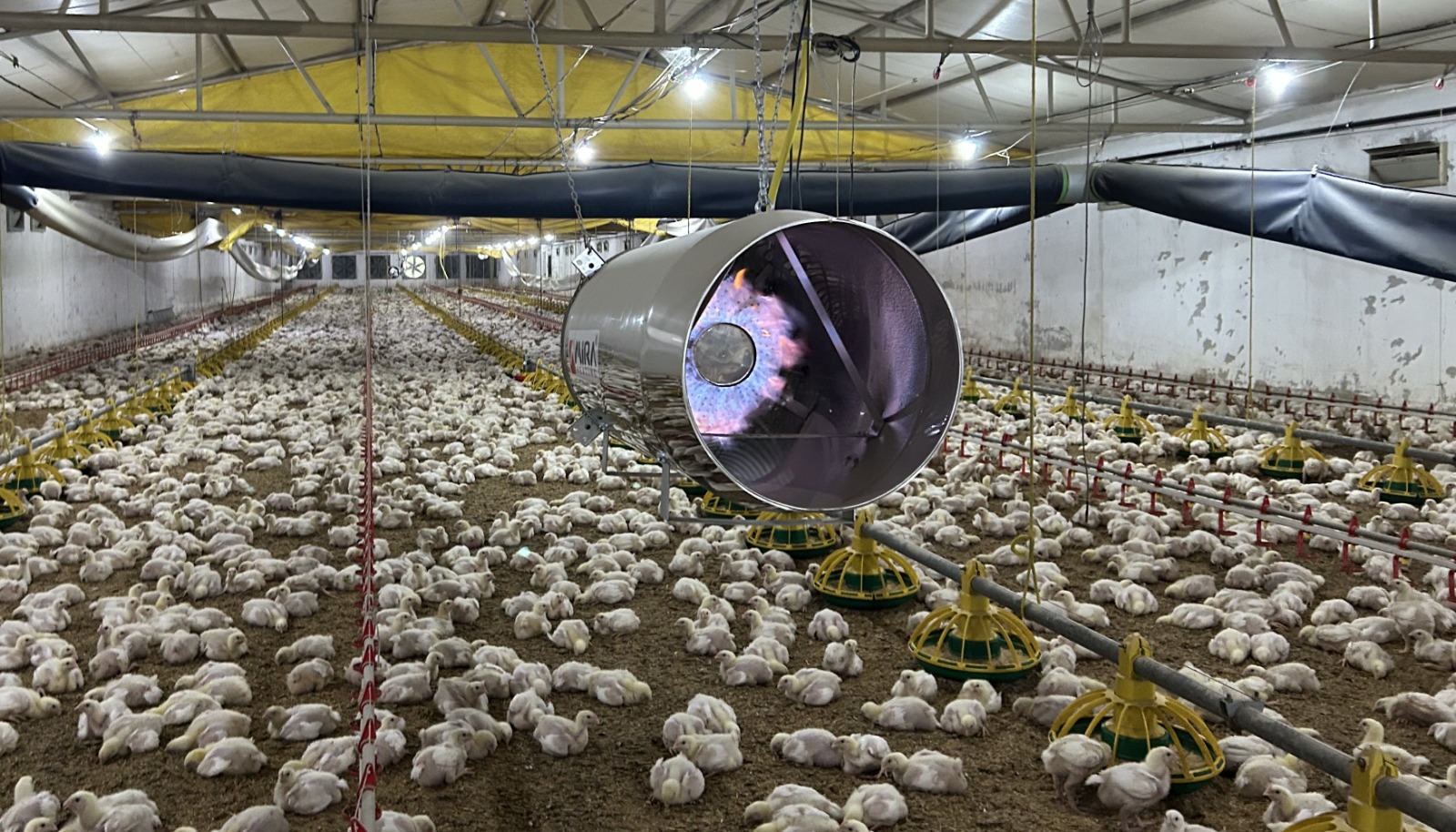
Ideal Temperature for Broiler Chickens: Complete Poultry House Temperature Guide
Maintaining the correct temperature is one of the most important aspects of successful broiler production.
Young chicks are particularly sensitive to temperature because they cannot regulate their body temperature as effectively as older birds. During the first weeks of production, an appropriately heated and well-managed poultry house can help create the environmental conditions required for healthy growth and uniform flock development.
As broilers grow, their temperature requirements gradually change. For this reason, poultry house heating should not be based on a single fixed temperature throughout the production cycle.
In this guide, we explain how temperature requirements change as broiler chickens grow, how to recognize temperature-related problems through bird behaviour, and how the heating and ventilation systems should work together.
Why Is Temperature So Important for Broiler Chickens?
Temperature affects much more than the comfort of the birds.
If chicks are exposed to temperatures that are too low, they may use more of their available energy to maintain body temperature instead of using that energy for growth.
When temperatures are too high, birds may move away from the heat source, reduce their activity and consume more water.
Maintaining an appropriate thermal environment can therefore contribute to:
- Healthy chick development
- More uniform flock distribution
- Efficient feed and water consumption
- Better growth performance
- Improved bird comfort
- More efficient use of heating energy
Temperature management should therefore be considered together with ventilation, humidity, air quality, litter conditions and stocking density.
What Is the Ideal Temperature for Broiler Chickens?
There is no single temperature that is ideal for broilers throughout the entire production cycle.
The required temperature generally starts relatively high during the first days after placement and is gradually reduced as the birds grow.
A typical brooding program may follow a pattern similar to the following:
| Bird Age | Approximate House Temperature |
|---|---|
| Day 1 | 32–35°C |
| Days 2–7 | 30–33°C |
| Week 2 | 28–30°C |
| Week 3 | 26–28°C |
| Week 4 | 23–26°C |
| Later stages | Gradually reduced according to bird condition |
These values are general guidelines rather than universal requirements. Actual temperature targets can vary according to genetics, house design, ventilation, litter conditions, humidity, stocking density and local production practices.
The behaviour and distribution of the birds should always be considered alongside temperature measurements.
Temperature During the First Days
The first few days are among the most critical stages of broiler production.
Newly placed chicks have limited ability to regulate their body temperature. They therefore depend heavily on the environmental conditions created by the poultry house heating system.
The brooding area should provide a warm and stable environment while allowing chicks to move freely between warmer and cooler areas.
A properly heated poultry house should not simply create a high temperature. It should create a uniform thermal environment without excessive hot or cold zones.
How Bird Behaviour Shows Temperature Problems
One of the simplest ways to evaluate the heating conditions in a poultry house is to observe the birds.
- Chicks gathering under the heaters — If chicks are tightly grouped directly below the heat source, the surrounding environment may be too cold. This behaviour indicates that the birds are attempting to reduce heat loss by staying close together and close to the heater.
- Chicks moving far away from the heaters — If birds are concentrated at the edges of the heating zone and avoid the heater area, the temperature may be too high.
- Birds gathering on one side of the house — This may indicate uneven temperature distribution, drafts or an airflow problem rather than simply an incorrect thermostat setting.
- Birds evenly distributed throughout the house — When chicks are generally active and evenly distributed across the available area, this is usually a positive indication that the thermal environment is appropriate.
Temperature and Ventilation Must Work Together
One of the most common mistakes in poultry house climate management is treating heating and ventilation as two completely separate systems.
They are directly connected.
Poultry houses require fresh air to control:
- Carbon dioxide
- Humidity
- Dust
- Ammonia
- Excess heat
However, bringing cold outside air into the building also increases the heating requirement.
The goal is therefore not to minimize ventilation in order to retain heat.
The goal is to provide the required fresh air while maintaining an appropriate temperature.
A properly designed poultry house should allow fresh air to enter, mix correctly with the warmer internal air and reach the birds without creating harmful drafts.
Why Uniform Temperature Distribution Matters
The temperature shown by a thermostat does not necessarily represent the conditions experienced by every bird in the poultry house.
A large poultry house can contain different temperature zones depending on:
- Heater location
- Air movement
- Building insulation
- Ventilation inlets
- Outside temperature
- House dimensions
- Heater capacity
For example, a poultry house may have a thermostat showing 30°C while some areas remain significantly colder.
This is why heat distribution is just as important as heating capacity.
Our guide on heater placement explains how heater positioning can influence temperature distribution throughout a poultry house: https://www.miraheating.com/haber-heater-placement-poultry-houses
Brooding Temperature and Heating Systems
The heating system must be capable of responding to the changing requirements of the flock.
During the early brooding period, the heating demand can be significantly higher than during later stages.
As the birds grow, their own metabolic heat production also increases. At the same time, the required environmental temperature gradually decreases.
This means that an effective heating system should provide:
- Sufficient capacity during cold periods
- Reliable temperature control
- Appropriate heat distribution
- Efficient fuel consumption
- Compatibility with the ventilation system
Natural Gas and LPG Poultry Heating
Natural gas and LPG are widely used for poultry house heating because they can provide high heating capacity and rapid response.
Forced-air gas heaters distribute heated air throughout the building and can be suitable for large poultry houses when correctly designed and positioned.
Mira Heating provides poultry heating systems designed for natural gas and LPG applications: https://www.miraheating.com/agh-dogalgazlpgli-kumes-isitici
The correct heater capacity depends on factors such as house dimensions, insulation, outdoor temperature and ventilation requirements.
Diesel Poultry Heating
Diesel-fired heaters are another option for poultry farms, particularly in locations where natural gas infrastructure is unavailable.
Diesel heaters can provide high heating capacity and rapid heating, making them suitable for applications where significant amounts of heat are required.
Mira Heating's diesel heating solutions are available for poultry and agricultural applications: https://www.miraheating.com/mira-adh-mazotlu-isitici
Fuel availability, operating costs and local conditions should be considered when comparing diesel with other heating options.
Electric Poultry Heating
Electric heaters can be used in smaller poultry houses, specific areas or as supplementary heating systems.
Electric heating eliminates the need for combustion fuel at the heater itself, but the available electrical infrastructure and electricity cost should be evaluated carefully.
Mira Heating also provides electric fan heaters for poultry and agricultural applications: https://www.miraheating.com/eh-36-elektrikli-fanli-isitici-kumes-sera-isitici
What Happens When the Poultry House Is Too Cold?
Low temperatures can create several problems.
Chicks may:
- Gather together
- Remain close to heat sources
- Reduce movement
- Consume more energy for maintaining body temperature
- Become unevenly distributed
Cold conditions can also interact with other environmental problems, particularly drafts and poor litter conditions.
The solution is not always simply increasing the thermostat setting.
The heating capacity, insulation, air inlets and ventilation system should be evaluated together.
What Happens When the Poultry House Is Too Hot?
Excessive temperature can be equally problematic.
Birds may:
- Move away from heaters
- Increase water consumption
- Reduce feed intake
- Spread their wings
- Become less active
When temperatures are too high, increasing heating capacity is obviously not the solution.
Instead, ventilation and airflow must be evaluated to determine whether heat can be removed effectively from the building.
How Can Poultry Farms Maintain Stable Temperature?
Maintaining a stable environment requires more than installing a heater.
Several factors should be considered together.
- Good insulation — Proper insulation reduces heat loss through the walls, roof and other building surfaces.
- Correct heating capacity — The heating system must be sized according to the actual heat loss and environmental conditions.
- Proper heater placement — Heaters should be positioned to provide effective heat distribution without creating excessive hot spots.
- Controlled ventilation — Fresh air should enter the house without creating harmful drafts or unnecessary heat loss.
- Regular monitoring — Temperature sensors should be positioned appropriately, and bird behaviour should be monitored regularly.
- Proper maintenance — Burners, fans, controls and other components should be inspected regularly to maintain reliable performance.
Temperature Management Is More Than a Thermostat Setting
One of the most important principles of poultry house heating is that the temperature displayed on a control panel is only one part of the picture.
The real objective is to create a stable environment at bird level.
For this reason, poultry producers should consider:
- Air temperature
- Floor temperature
- Humidity
- Air velocity
- Bird distribution
- Ventilation
- Heating capacity
- Heat distribution
A well-designed poultry heating system should work together with the complete climate management system.
Conclusion
Maintaining the appropriate temperature is essential for successful broiler production, particularly during the first weeks of the flock.
Temperature requirements change as birds grow, which means that heating systems and environmental controls must be able to adapt throughout the production cycle.
The most important principles are:
- Start with appropriate brooding temperatures.
- Gradually adjust temperature as birds grow.
- Observe bird behaviour rather than relying only on thermostat readings.
- Maintain uniform heat distribution.
- Avoid excessive drafts.
- Coordinate heating with ventilation.
- Select the appropriate heating technology and fuel for the farm.
Natural gas, LPG, diesel and electric heating systems can all be suitable depending on the farm's infrastructure, climate and operating requirements.
By combining appropriate heating equipment with good ventilation, insulation and temperature management, poultry producers can create a more stable environment for their flock and use heating energy more efficiently.
For more information about poultry heating systems and how to select the right solution for your farm, explore Mira Heating's range of natural gas, LPG, diesel and electric poultry heating solutions.