
Brooding Temperature Management in Poultry Farms
Brooding Temperature Management in Poultry Farms

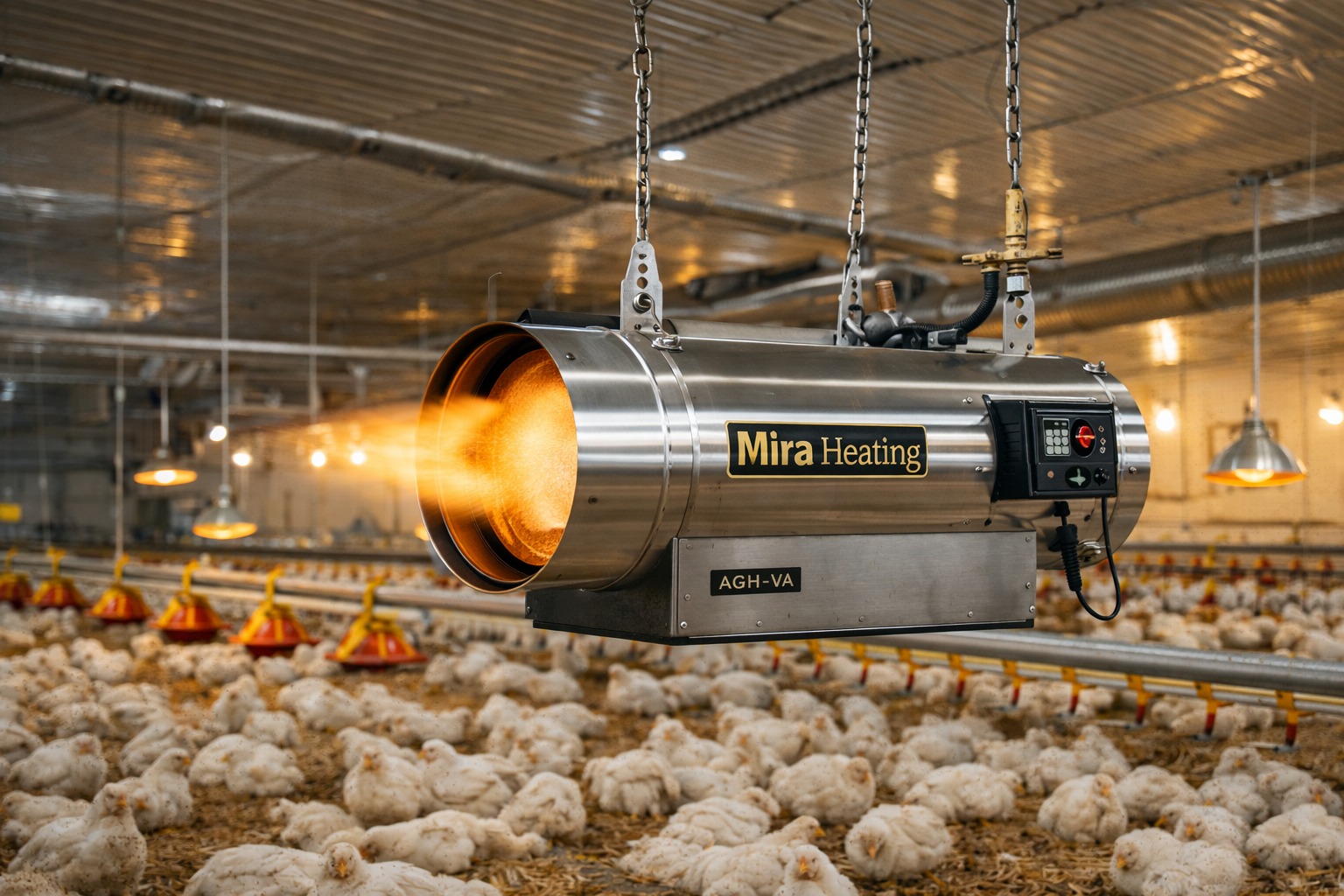
Brooding Temperature Management in Poultry: A Practical Guide
The first days of a broiler flock are among the most important stages of poultry production.
Newly placed chicks are highly sensitive to their environment and have limited ability to regulate their own body temperature.
For this reason, maintaining the correct brooding temperature is essential.
However, successful brooding is not simply about setting a thermostat to a particular temperature.
The poultry house must provide a suitable combination of:
- Temperature
- Floor temperature
- Air quality
- Ventilation
- Humidity
- Air movement
- Heating capacity
- Temperature uniformity
A well-designed heating system can help maintain these conditions, but the heating equipment must work together with ventilation and flock management.
Why Is Brooding Temperature So Important?
Young chicks cannot regulate their body temperature as effectively as older birds.
If the environment is too cold, chicks may lose body heat and consume additional energy simply to stay warm.
If the environment is too hot, chicks may move away from the heat source and reduce their activity.
Both situations can negatively affect flock distribution and development.
The objective during brooding is therefore to create a stable and comfortable thermal environment in which chicks can access the conditions they need without excessive temperature variation.
What Temperature Do Broiler Chicks Need?
The exact target temperature depends on several factors, including:
- Chick age
- Housing system
- Brooding method
- Floor temperature
- Litter condition
- Relative humidity
- Air movement
- Bird behaviour
Newly placed chicks generally require a warmer environment than older birds.
As the flock develops, the required temperature can gradually decrease.
Rather than relying on a single fixed number, producers should follow the temperature program appropriate for their genetics, housing and production system.
Temperature should also be verified at chick level rather than only at the height of a wall-mounted thermostat.
The First Hours Are Critical
The period immediately after chick placement deserves particular attention.
The poultry house should already be prepared before the chicks arrive.
Preheating should provide enough time for the building and its internal surfaces to reach the required conditions.
Important areas include:
- Air
- Floor
- Litter
- Walls
- Equipment
If only the air is heated immediately before placement, the floor and surrounding surfaces may remain colder than expected.
This can affect the thermal environment experienced by the chicks.
Preheating the Poultry House
A good preheating process should begin sufficiently early before chick placement.
The exact preheating time depends on:
- Building construction
- Outdoor temperature
- Insulation
- Heating capacity
- Floor construction
- Litter depth
The objective is not simply to make the air warm.
The entire brooding environment should be stabilized.
This is especially important during cold weather when building surfaces can remain cold even after the air temperature reaches the target value.
Floor Temperature Matters
Chicks spend much of their time in contact with the floor or litter.
For this reason, floor temperature is an important part of brooding management.
A poultry house can show an acceptable air temperature while the floor remains too cold.
This is one reason why temperature measurements should not be limited to a single sensor.
The condition of the litter should also be considered.
Cold or wet litter can create an uncomfortable environment even when the air temperature appears acceptable.
Temperature Uniformity Is More Important Than One Temperature Reading
A poultry house can have an average temperature that looks correct while still containing areas that are too cold or too warm.
Temperature should therefore be evaluated at multiple locations when possible.
Differences can occur because of:
- Heater placement
- Airflow
- Ventilation
- Building insulation
- Air leakage
- Door openings
- Outdoor conditions
A good heating system should help create a relatively uniform environment throughout the bird area.
How Should Chicks Behave?
Bird behaviour is one of the best practical indicators of brooding conditions.
Chicks too cold
When chicks are too cold, they may gather closely together and concentrate near the heating source.
This can indicate that the surrounding environment is not warm enough.
Chicks too hot
When chicks are too warm, they may move away from the heat source and spread toward the edges of the brooding area.
They may also show reduced activity.
Comfortable chicks
When the environment is appropriate, chicks should generally be distributed more evenly and remain active.
Bird behaviour should always be evaluated together with temperature measurements.
Heating and Ventilation Must Work Together
One of the biggest challenges during winter brooding is balancing heating with ventilation.
Chicks require fresh air even when outdoor temperatures are low.
Ventilation helps control:
- Carbon dioxide
- Humidity
- Ammonia
- Dust
- Air quality
However, ventilation also introduces cold outdoor air and removes warm indoor air.
This creates additional heating demand.
The objective is therefore not to reduce ventilation as much as possible.
The objective is to provide the required amount of fresh air while minimizing unnecessary heat loss.
Minimum Ventilation During Brooding
Minimum ventilation is especially important during the early stages of production.
Fresh air should enter through controlled air inlets rather than uncontrolled gaps.
The incoming air should ideally be directed and mixed with warmer indoor air before reaching the birds.
Poorly controlled air entry can create drafts at bird level.
A heating system should therefore be designed together with the ventilation system.
Avoid Drafts at Chick Level
Drafts can be particularly problematic during brooding.
Even when the average temperature is correct, excessive air movement at chick level can make the environment feel significantly colder.
Potential sources include:
- Incorrectly adjusted air inlets
- Door gaps
- Building leakage
- Poorly positioned fans
- Incorrect heater airflow
Air movement should therefore be considered alongside temperature.
Forced-Air Heating for Brooding
Forced-air heating systems generate heat and distribute it through the poultry house using fans.
This approach can be particularly useful in larger commercial poultry houses.
The warm air can be distributed throughout the building, helping maintain a broader ambient temperature.
However, heater placement and airflow must be carefully considered.
The objective is to distribute heat without creating excessive air movement at bird level.
Mira Heating provides forced-air poultry heating systems using natural gas, LPG, diesel and electric technologies.
Natural Gas and LPG Heating
Natural gas can provide an efficient heating solution where gas infrastructure is available.
LPG provides a flexible alternative for farms without access to a natural gas network.
Both can provide high heating capacity for commercial poultry houses.
Mira Heating's AGH poultry heaters are designed for natural gas and LPG applications:
https://www.miraheating.com/agh-dogalgazlpgli-kumes-isitici
Diesel Heating for Poultry Farms
Diesel-fired heating can be useful for poultry farms where diesel is readily available or where natural gas infrastructure is limited.
Forced-air diesel heaters can provide rapid heating and high heating capacity.
Fuel consumption should be evaluated together with local diesel prices and expected operating hours.
Mira Heating provides diesel heating solutions for agricultural applications:
https://www.miraheating.com/mira-adh-mazotlu-isitici
Electric Heating During Brooding
Electric heating can be suitable for smaller poultry houses, supplementary heating or applications where sufficient electrical capacity is available.
Electric heaters can provide a practical solution without requiring fuel storage.
However, electricity costs should be considered carefully for high-capacity commercial heating applications.
Mira Heating's electric fan heaters are suitable for poultry and agricultural applications:
https://www.miraheating.com/eh-36-elektrikli-fanli-isitici-kumes-sera-isitici
Heater Placement During Brooding
The position of the heating equipment can significantly affect brooding conditions.
A heater should be positioned so that heat reaches the required areas without creating excessive air movement.
Poor placement can create:
- Hot zones
- Cold zones
- Uneven chick distribution
- Increased fuel consumption
The building dimensions and ventilation layout should be considered before finalizing heater positions.
Our detailed guide explains this subject further:
https://www.miraheating.com/haber-heater-placement-poultry-houses
How Does Brooding Temperature Change With Age?
Brooding temperature should not remain constant throughout the production cycle.
As chicks grow, their ability to regulate body temperature improves.
The target environment can therefore gradually become cooler.
The exact temperature schedule should be determined according to:
- Bird genetics
- Production system
- Housing conditions
- Climate
- Flock behaviour
A controlled reduction in temperature can help avoid unnecessary heating costs while maintaining suitable conditions for the flock.
Avoid Overheating
Overheating can be just as problematic as insufficient heating.
If the heating system is operated at unnecessarily high temperatures:
- Energy consumption increases
- Birds may move away from heated areas
- Ventilation requirements may increase
- Temperature uniformity can deteriorate
The objective is to provide the temperature the birds actually need rather than simply maximizing heating output.
Use Temperature Sensors Correctly
Temperature sensors should be installed where they provide meaningful information about the environment experienced by the flock.
A sensor positioned too close to a heater can record an artificially high temperature.
This can cause the heating controller to reduce output while other areas remain cold.
Sensors should therefore be positioned carefully and, where appropriate, multiple measurement points should be used.
Monitor More Than Temperature
Temperature is only one part of brooding management.
Other environmental factors include:
- Relative humidity
- Air quality
- Air movement
- Litter condition
- Carbon dioxide
- Ammonia
A poultry house can have the correct temperature while still having poor air quality.
This is why heating and ventilation must always be managed together.
How Efficient Heating Reduces Energy Consumption
Efficient brooding is not about running the heaters less regardless of conditions.
It is about delivering the required heat with minimal unnecessary losses.
Energy efficiency can be improved through:
- Good insulation
- Controlled air leakage
- Correct heater sizing
- Proper heater placement
- Accurate temperature control
- Appropriate ventilation
- Regular maintenance
Our guide on reducing heating costs explains these principles in more detail:
https://www.miraheating.com/haber-reduce-heating-costs-poultry-farms
Common Brooding Temperature Mistakes
Several common mistakes can reduce heating efficiency and affect flock conditions.
- Relying on one temperature sensor
One sensor may not represent the entire poultry house. - Ignoring floor temperature
The floor and litter can remain cold even when the air temperature is acceptable. - Reducing ventilation too much
Saving heating energy at the expense of air quality is not an effective solution. - Poor heater placement
Incorrect positioning can create significant temperature differences. - Overheating the entire building
Not every area necessarily requires the same amount of heat. - Ignoring bird behaviour
The flock itself provides valuable information about the environmental conditions.
A Practical Brooding Checklist
| Stage | Checklist Items |
|---|---|
| Before chick placement |
|
| After chick placement |
|
Brooding Temperature Is a Complete Climate Management Process
Successful brooding requires more than a heater.
The heating system must work together with:
Heating + Ventilation + Insulation + Airflow + Temperature Control + Flock Management
When these elements are properly coordinated, the poultry house can maintain more stable conditions while avoiding unnecessary energy consumption.
Conclusion
Brooding temperature management is one of the most important aspects of poultry production.
Young chicks require a stable and carefully controlled environment, particularly during the first days after placement.
Successful brooding depends on more than air temperature alone.
Floor temperature, ventilation, air movement, humidity, insulation and bird behaviour must all be considered.
A properly designed heating system can provide the required heat, but it must be correctly sized, installed and controlled.
Natural gas, LPG, diesel and electric heating systems can all be effective depending on the poultry house, local infrastructure and production requirements.
At Mira Heating, we provide natural gas, LPG, diesel and electric heating solutions for poultry farms and agricultural applications. If you are planning a new broiler house or looking to improve your existing brooding system, contact our team with your poultry house dimensions, location, bird capacity and available fuel options so we can help you evaluate the appropriate heating solution.